
A case study on reduced downtime and smarter processes in final packaging.
When palletizing stalls: Familiar challenges in final packaging
Increasing efficiency is a central goal for modern production facilities – but especially for high-volume products with high output, such as bottles, buffer storage is not practical. This means that disruptions in final packaging often cause complete line stoppages.
Complex processes, unclear fault messages, and a lack of technical expertise lead to valuable production time being lost. Employees walk between levels and plant components because signal lights do not clearly indicate where the fault lies. At the same time, many logistics employees lack the training to quickly identify causes and resolve them independently.
Such challenges are widespread in practice: they occur daily in numerous production lines – especially in the food and beverage industry. In the project with Rotkäppchen-Mumm, these very problems were central obstacles on the path to greater efficiency.
How can typical disruptions in final packaging be resolved faster – and thus achieve real efficiency improvement?
The answer lies in a digital approach that systematically leverages experiential knowledge.
Together with Peerox, a solution approach was implemented that shows: Efficiency improvement is possible – through intelligent knowledge management, targeted root cause analysis, and software-supported employee assistance.
Knowledge that works: How Peerox uses MADDOX to make fault causes transparent and design smarter processes
With the introduction of
The special feature: If the cause is still unknown to the person on site, they refer to the adjacent tablet. There, they find a structured knowledge base – including images, videos, and concrete solution proposals, most of which were entered by technical colleagues themselves. This allows experiential knowledge to be accessed, supplemented, and used directly at the point of action.
If the person confirms the solution, this information is used for further system improvement: The AI-powered search algorithm in
The result: fewer unnecessary paths, shorter reaction times, and measurable efficiency improvement in the line.
Logistics employee Dieter is happy because he has to resolve problems less often and saves unnecessary trips. He prefers to get his cardio points on his fitness tracker by cycling in nature rather than climbing stairs at the noisy palletizer.
Measurable Efficiency Improvement: Practical Example from the Food Industry with Rotkäppchen-Mumm
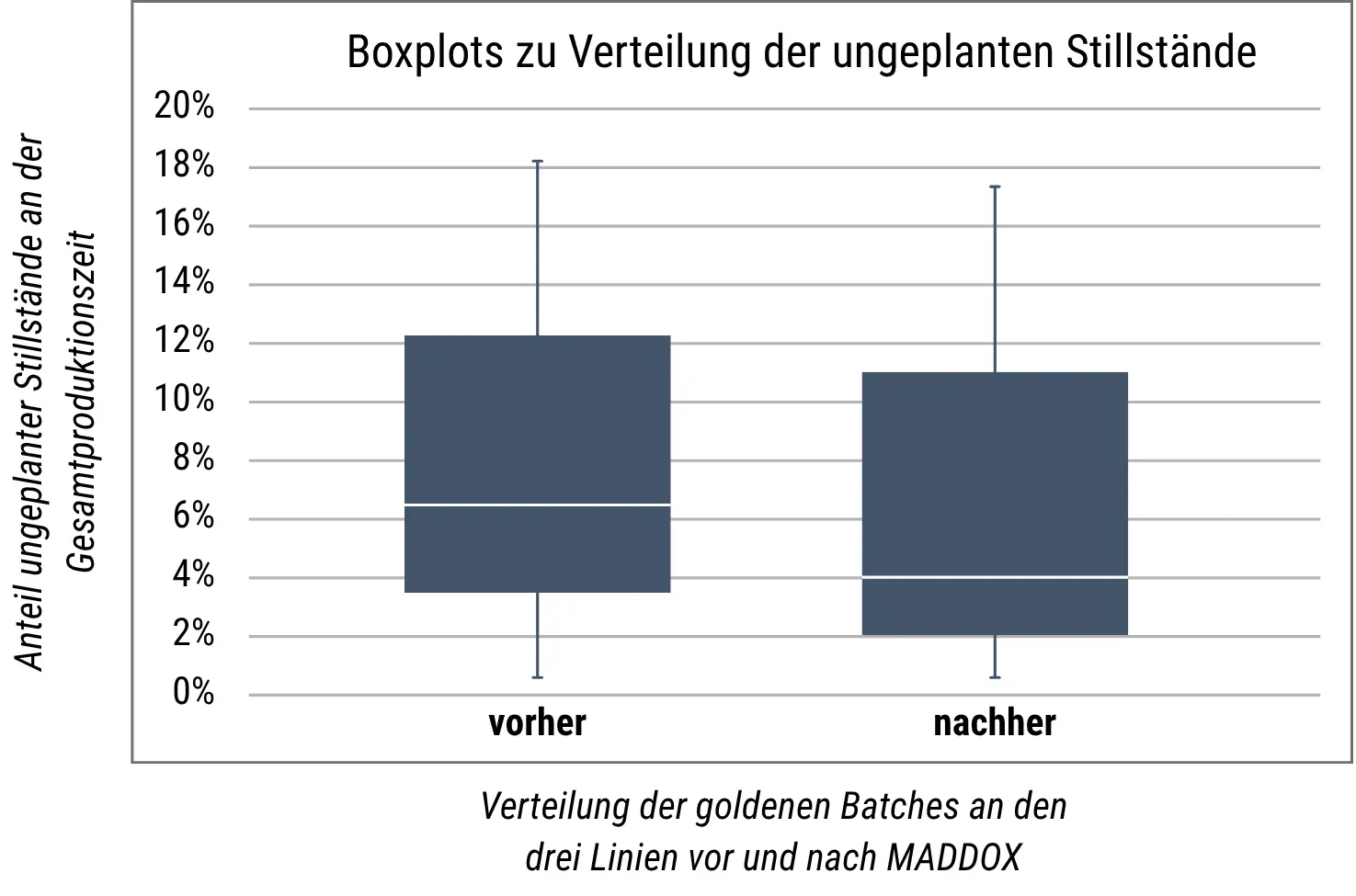
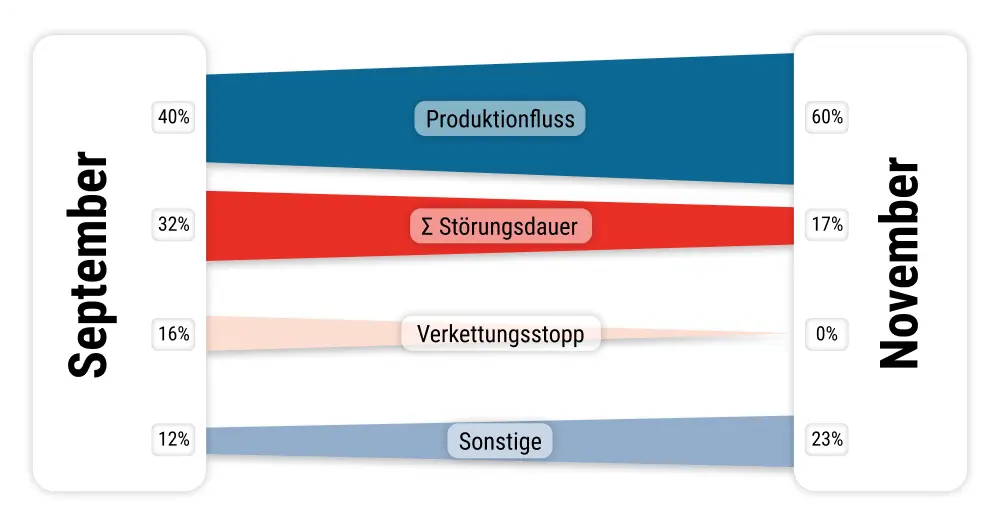
The pilot project with Rotkäppchen-Mumm clearly shows: Efficiency improvement is not just a goal, but a measurable result. The proportion of “time without disruption” could be increased month after month in the observed lines after the commissioning of MADDOX – particularly visible in small filling (bottling line for piccolo bottles) in November, where disruption-free production time reached the highest proportion of machine running time.
Further evidence of this is the development of the average disruption duration for frequently occurring error codes. The following graphic exemplarily shows how the duration for errors 2202 and 2145 significantly reduced over three months. Especially for these frequent disruptions, the use of MADDOX led to faster reactions, more targeted measures, and a noticeable relief for employees.
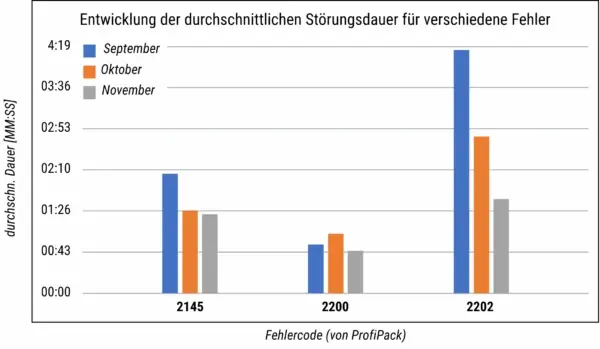
These advances were not only visible but also actively utilized: The consistently high system usage and positive feedback confirm the everyday suitability of the solution – from the worker to the technician.1
1) Peerox uses the presented evaluations together with its customers during the piloting and implementation process of MADDOX. This ensures that the system rollout does not follow the “train and hope” principle, but is data-driven, controlled, and plannable. Acceptance problems, retraining needs, and other obstacles in the change process accompanying the introduction can be immediately identified and addressed in a targeted manner. Data evaluation and usage are carried out according to an anonymization procedure developed in cooperation with works councils.