

Practical Guide
Increased production efficiency through knowledge management
Why some manufacturing companies resolve malfunctions faster than others
When a system comes to a standstill, it is often not the technology that determines the duration of the downtime – but the available knowledge. In many manufacturing plants, rapid troubleshooting still depends on the experiential knowledge of individual employees. This knowledge is often stored in people's heads, old shift logs, Excel files, or scattered documentation.
The result:
Recurring malfunctions are solved from scratch every time
Experienced employees are constantly called in for the same problems
New employees require long onboarding periods
Valuable knowledge is lost due to staff turnover
Unplanned downtime causes avoidable costs
The Eldorado of efficiency
Manufacturing companies invest significant resources in machinery, automation, and processes. Yet, much potential remains untapped. Our experience from numerous industrial projects shows: the difference between average and highly efficient production is often not a technical problem – but a knowledge problem. While experienced employees can often resolve malfunctions within minutes, less experienced colleagues take significantly longer. The cause is rarely a lack of motivation, but usually a lack of access to situation-relevant knowledge. Effective knowledge management ensures that experiential knowledge is available where it is needed: directly at the machine.
reduce unplanned downtime
secure knowledge for the long term
empower employees faster
eliminate the causes of malfunctions more sustainably
continuously improve production processes
Why many knowledge management projects fail
The crucial insight
Many companies try to encourage as many employees as possible to actively document knowledge. However, our experience shows a different picture: only a few active knowledge carriers are sufficient if the vast majority of employees use the provided content regularly.
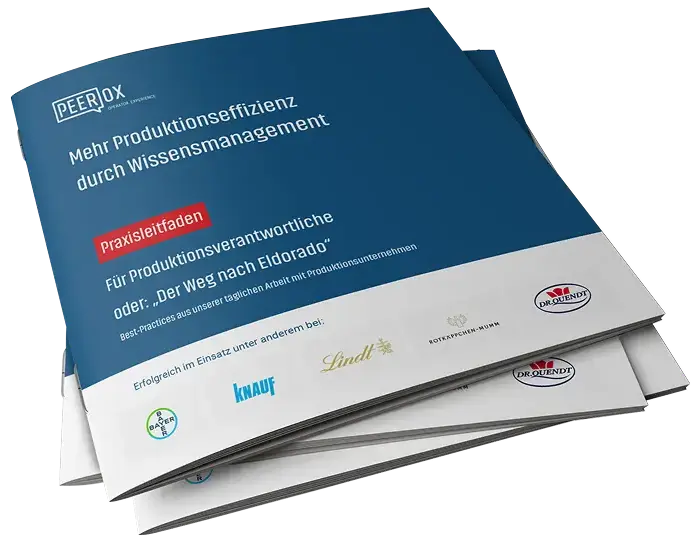
Download the complete practical guide for free
25 pages of best practices, checklists, and experiences from real production projects.
In the full white paper, you will learn: