
Machine downtime: The (in)visible costs for your production
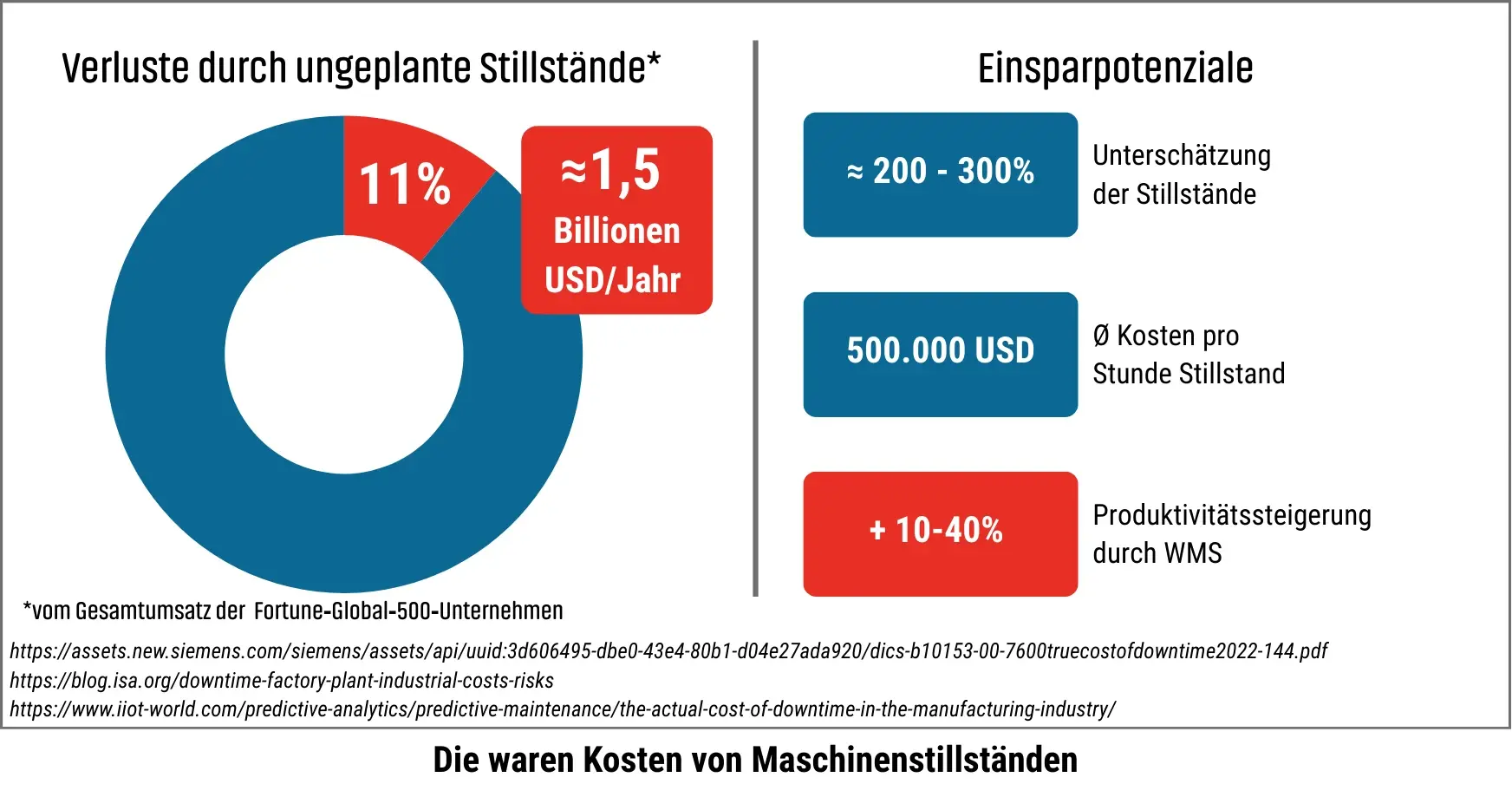
Machine downtime is one of the biggest cost drivers in industry. According to the Siemens report “The True Cost of Downtime 2022”, based on surveys from 2021–22, Fortune Global 500 companies lose around 11% of their annual revenue due to unplanned outages—equivalent to nearly US$1.5 trillion per year.
According to the International Society of Automation, every factory loses at least 5% of its productive capacity each year due to downtime—many even up to 20%.
It is crucial to analyse the figures clearly in order to understand the true causes of downtime. Only a careful analysis of the figures reveals the hidden depth of the problem and opens the way to effective measures.
Between staff shortages and demographic change: Why companies are facing a double challenge
Downtime is not all the same: Planned breaks (e.g. maintenance, changeovers), avoidable stoppages (e.g. material shortages) and unplanned outages (e.g. defects) differ in their causes—but they have one thing in common: costs rise with every minute.
This issue is compounded by another, often underestimated challenge: staff shortages. Maintenance takes longer, faults are harder to fix, and new employees need significantly more time to build up the necessary experience. At first glance, it therefore seems as if there is simply too little staff.
But on closer inspection, it becomes clear: the real bottleneck is a lack of knowledge management—especially in finding knowledge and in knowledge transfer. Without systematically accessible know-how, dependencies on individuals arise, and downtime lasts longer and costs more than necessary.
Peerox combines knowledge and AI: a solution for fewer failures and dealing with staff shortages
In many production plants, the same scenario repeats itself: faults occur that drive up costs, while at the same time there is a shortage of staff.
When a fault occurs, operators look for the cause—but even if the best database were available, the problem would often remain unsolved. The reason: to use knowledge from a traditional database, you need to know the keywords and use them correctly. But often that is exactly what is missing: the right term for the component or the type of fault. This keeps the cause hidden and delays the solution.
This is exactly where
MADDOX is the result of years of research at Fraunhofer IVV Dresden and close collaboration with psychologists. A well-known problem in production: experienced employees often share their knowledge only reluctantly because they feel their efforts receive little recognition. With