

What constitutes good knowledge management in production
Good knowledge management fulfills several core principles:
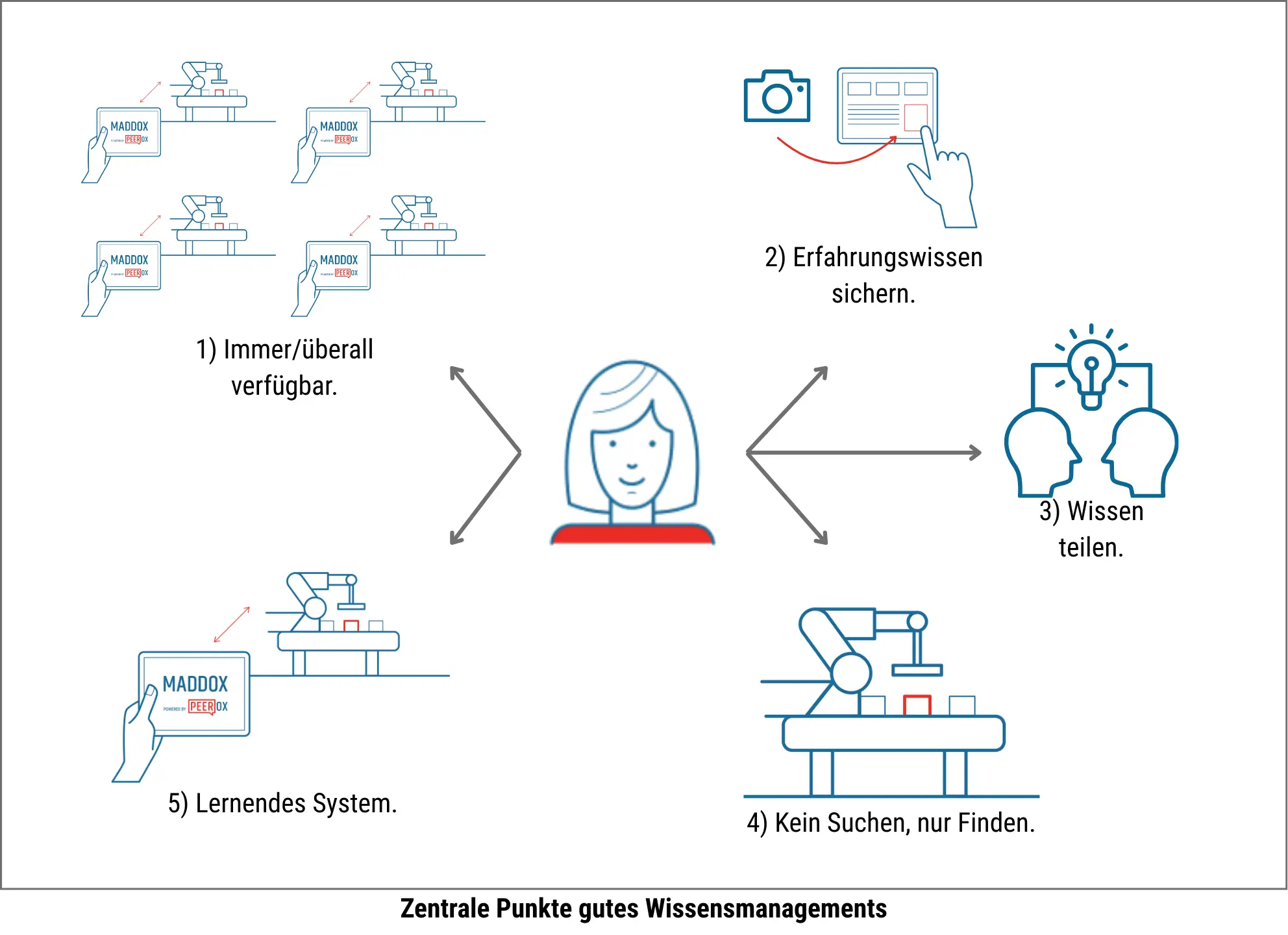
Knowledge must be available and usable when it is needed — not stored away somewhere, but actively accessible within the work context. A system that lies outside the daily workflow will be bypassed. Integration into existing processes determines acceptance. However, availability does not equal applicability. Knowledge only becomes effective when it is prepared in a way that is understandable and relevant to action within a specific context.
Experiential knowledge must be captured before it leaves the company. The implicit knowledge of experienced specialists is often the most valuable asset — and the most fragile. For it to enter the system, the capture process must be seamless. If documenting experiences is perceived as a bureaucratic burden, the system remains empty. Low barriers determine whether knowledge is captured at all.
People must be motivated to share and seek knowledge. This does not happen by itself. Sharing knowledge often feels risky; seeking knowledge requires effort. A good system reduces these hurdles instead of ignoring them.
Knowledge should come to the employee — not the other way around. Systems that require active searching lose out in everyday production. Relevant knowledge must appear at the right moment without having to be asked for.
Knowledge is not static. Processes change, machines are updated, and new insights emerge. A good system learns along with them — it grows and stays up to date.
Technology can enable the flow of knowledge — but it cannot force it. The decisive factor is whether the solution fits the workflows, whether it finds acceptance, and whether it brings knowledge to where it is needed. This is a matter of concept, not features.
Would you like to learn more about ‘Implementing Knowledge Management to Reduce Production Disruptions’? Our white paper provides you with sound fundamentals and a detailed practical guide. What do I need to consider when introducing knowledge management?
When AI Meets Principles
Modern AI systems process large amounts of data in real time, recognize patterns in complex data sets, and continuously improve their results through machine learning. Thus, AI offers enormous potential for knowledge management in production.
But these capabilities are tools, not finished solutions. The crucial question is: In what form and with what concept can this potential actually be utilized?
ChatGPT & Co.
With the rapid development of Large Language Models (LLMs) like ChatGPT, the topic of knowledge management seems to have been solved overnight. Therefore, many companies are currently focusing on the use of this technology, which is (incorrectly) equated with “AI” in general parlance. However, some fundamental limitations should be considered here, which will not be resolved in the near future even by the rapid further development of the models.
If you ask Large Language Models about a specific problem, you usually receive a very good, concrete solution (possible hallucinations aside). Example:
“I need to do an oil change on my Golf 5. How do I do that?”
In the event of a production disruption, however, you usually do not know the underlying problem, and finding it as quickly as possible is the central achievement of human experts. Therefore, LLMs are comparable to classic knowledge management systems without a data connection, which help experienced employees with a very targeted search query. For vague descriptions of symptoms such as
“I have a product jam at the outlet of my thermoforming machine. How do I solve the problem?”
you will either receive a long, generic list of results or the LLM will start a dialogue. The latter is often the case, especially with Retrieval-Augmented Generation (RAG) based systems with corresponding data sources in the background. In effect, the language model navigates you through a failure tree, just as human customer support has been doing on hotlines for decades. And what has your experience been with that so far? It can work, but it’s usually annoying and takes forever, right?
So, what if you provided the LLMs with additional contextual information, for example in the form of machine data? Admittedly, the models have become noticeably better in the area of data analysis recently, but they remain language models that can only cope with time-series data and binary signals from machine controls to a very limited extent. The underlying transformer technology is not the right approach for this.
Then there is the topic of image recognition, in which the latest generation of AI also performs impressively. In production practice, this simply fails due to the availability of training data. Try uploading a photo of a complex machine with a non-obvious problem and getting information about the cause. In all probability, the model — especially in the case of custom-built machinery — has never “seen” a detailed shot of the module in question, let alone the disruption. No matter how good the models are, they will only have a real chance when corresponding training data from the industry is available openly and in sufficient quantities, which will not be the case in the foreseeable future.
From Principle to Solution
It is sometimes forgotten that AI existed even before November 30, 2022 (the release of ChatGPT 3.5), with a huge range of algorithms for very different use cases. These include special machine learning methods for pattern recognition in typical time-series data from production processes. These learn quickly and are still so high-performing that they run on standard hardware on-premise.
And the missing training data from the industry? It already exists — as the experiential knowledge of the employees who work on the machines every day. This knowledge is often a company’s most valuable asset. The question is how it gets into the system. When sharing becomes as easy as taking a picture or a short video at the machine, experiential knowledge becomes usable. When one’s own experience visibly contributes to the solution, motivation increases. This creates the fuel that AI needs — not from external sources, but from within the company itself.
The path does not lead from the technology to the problem, but vice versa. Anyone who truly understands the challenges of knowledge management in production — why knowledge is not found, why systems are not used, why experience is lost — and who knows the principles that make for good knowledge management, can develop a solution that uses AI where its strengths lie. Not as an end in itself, but as an enabler.
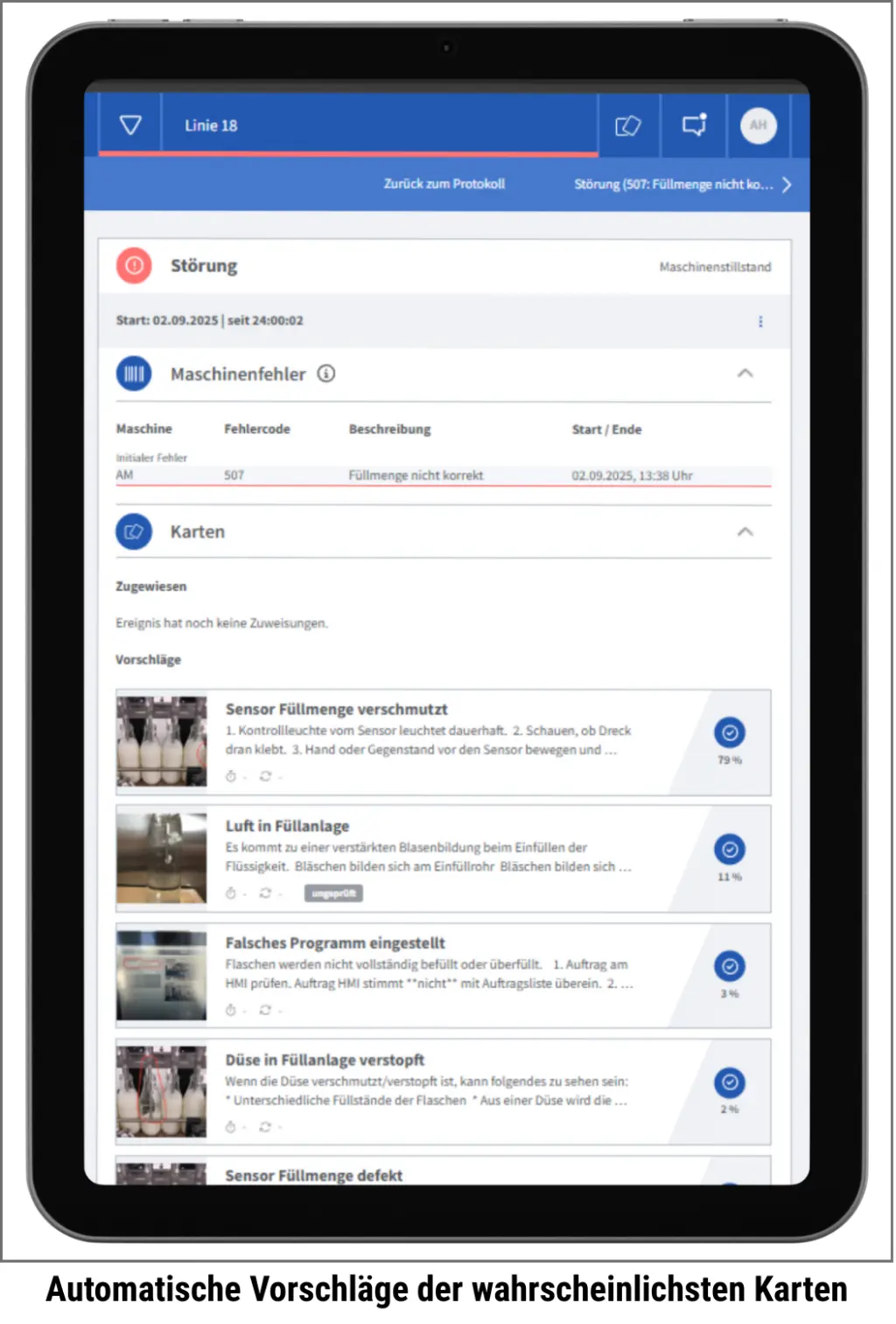
This creates a system that does not wait for an employee to ask the right question. It recognizes the situation — a disruption, a pattern, a context — and delivers the appropriate solution on its own. The knowledge appears when it is needed. Not because the technology dictates it, but because the principles require it. When a solution is developed on this basis, it does not simply result in digitalization — but in a fundamentally better way of handling knowledge in production.
LLMs remain a useful supplement — e.g., for more efficient writing or the logical structuring of knowledge entries. But they do not form the foundation.
MADDOX: Proven AI Solution for Knowledge Management in Production
In 2015, researchers at the Fraunhofer Institute for Process Engineering and Packaging (IVV) began their work — not to chase the hype or ride technological waves, but to dedicate themselves to a fundamental challenge: knowledge management in production and increasing production efficiency. By 2019, something had crystallized: an innovative solution that combines the power of an emerging technology with sound scientific research, production experience, and a central philosophy — that humans will be irreplaceable for the foreseeable future. This conviction led to psychological research in collaboration with TU Dresden to achieve the best harmony between humans and technology. The solution gained trust immediately. One of the most prestigious pharmaceutical companies in the world, Bayer, became an early adopter, followed by market leaders from various industries. The result: MADDOX — the AI-based solution for knowledge management in production.
What distinguishes MADDOX from traditional knowledge management solutions in production
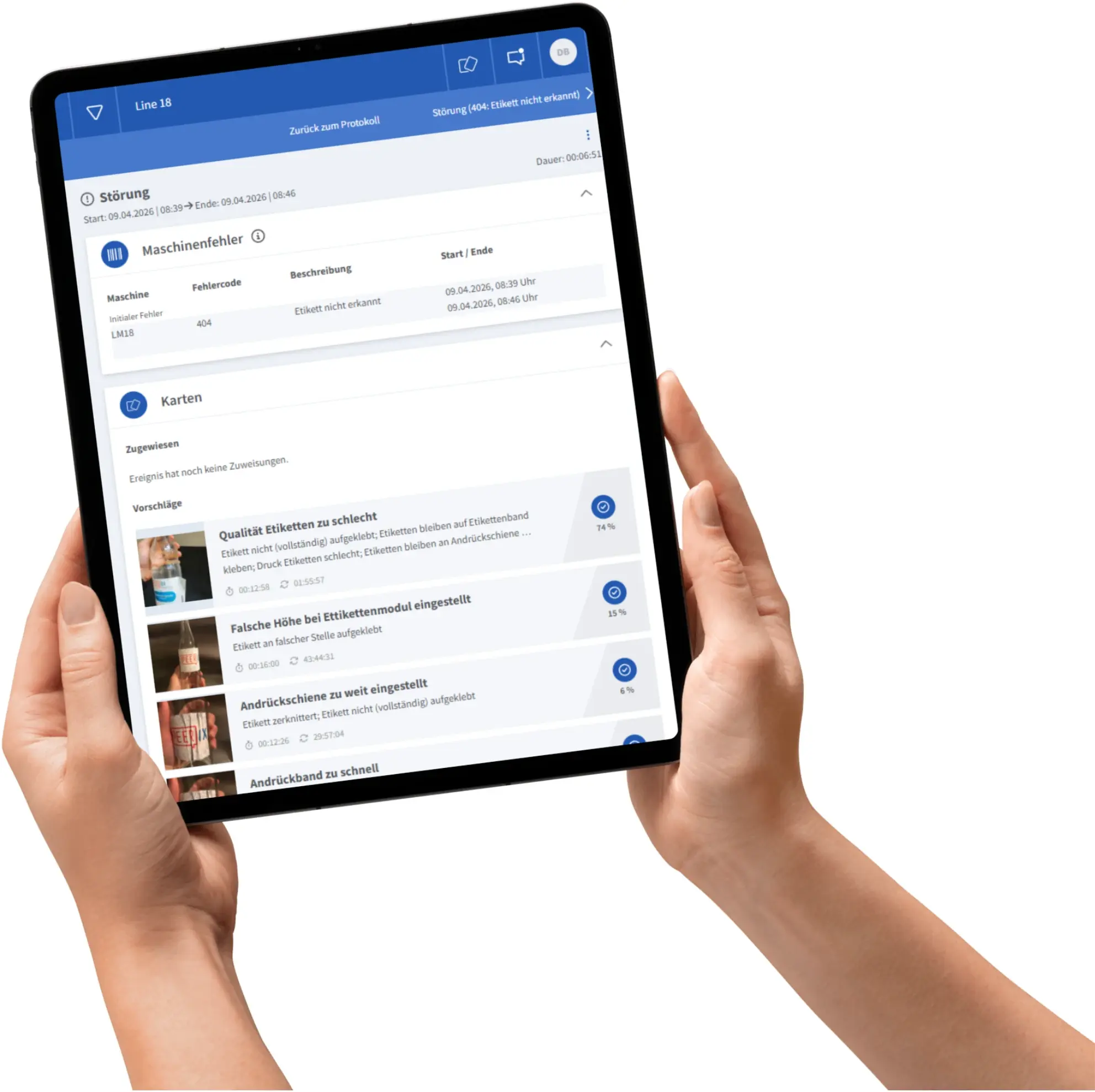
Instead of forcing employees to search through endless databases during a breakdown, MADDOX brings the solution directly to them. The system automatically recognizes disruptions and delivers the appropriate solution based on context — without employees having to search. The principle: Experienced maintenance technicians document their knowledge directly at the machine — a mobile phone video of the troubleshooting process, a photo of the critical point. MADDOX links this practical knowledge with live machine data. If a similar disruption occurs, the system automatically suggests the proven solution using machine learning algorithms.
Integration into Complex Production Environments
As a Fraunhofer spin-off, Peerox combines scientific excellence with implementation expertise. The integration team also incorporates MADDOX into highly complex production lines with demanding or incomplete data interfaces. The experts coordinate between various machine manufacturers, IT service providers, and internal systems — significantly relieving your project managers. You can read more about the proven success of MADDOX here: International pharmaceutical company from Germany achieves 7% more OEE with Peerox’s innovative knowledge management.