

“Every successful company has solved at least one difficult problem.”
When Knowledge Only Exists in People’s Heads: OEE and Quality Suffer
After a weekend shift with two temporary workers, OEE metrics are once again difficult to grasp – while quality issues pile up on the desk.
This indicates knowledge-intensive production: processes where products or auxiliary materials such as packaging fluctuate significantly are difficult to standardize. Illustrative examples:
- Nut chocolate with random nut distribution
- Sliced cheese with holes, the distribution of which influences moments of inertia and mechanical strength
- Recycled cardboard, whose processing properties depend on fiber quality, moisture, and storage conditions
Experienced employees often resolve such unplanned process disruptions through small adjustments, e.g., adjusting guides or parameter settings. Inexperienced workers, on the other hand, clear out, clean, restart machines, or call maintenance. This difference in experience levels can cause an OEE difference of over 20% between the “A-team” and the “C-team.”
Could Knowledge Documentation Be the Strategic Problem of Your Production?
“Every successful company has solved at least one difficult problem.”
This sentence can also be viewed in reverse: If a company has only solved relatively simple problems that most others can also solve, then it almost certainly has exactly one problem: competition.
This drives prices down and erodes margins.
On the other hand, many examples on the market show how solving difficult problems creates successful companies: Tesa and Tempo managed, through outstanding marketing for what are inherently very simple products, to make their own brand synonymous with an entire product category. Novo Nordisk was able to solve a long-standing problem in pharmaceutical research with the weight-loss drug Wegovy. SpaceX solved the structural-technical problem of reusable rockets, enabling price leadership while maintaining high margins. Ford achieved the same goal at the beginning of the last century by solving process and HR problems (introduction of the assembly line and far above-average pay for good workers). The more of these difficult problems you solve (e.g., Apple: technology and marketing), the better your company is positioned.
If you have identified the topic of (experiential) knowledge as a – undoubtedly difficult – problem in everyday production, you should first check whether an outstanding solution would have the potential for success to leave your competitors far behind. Could you take over price leadership (with stable or growing margins) through far fewer unplanned process disruptions than the industry average? Could you become the leader in delivery times, adherence to schedules, and/or quality? Would you be the only ones in your industry spared from the crisis caused by demographic change? Could you be the only ones to establish highly knowledge-intensive production in locations with extreme skilled labor shortages but very low labor costs?
If this potential for success is limited or non-existent in your situation, then you should focus on other difficult problems (technology, marketing, etc.) to bring your company into a successful market position or to defend it. This does not mean that you may neglect the influence of knowledge on your business success. You will still need committed specialists, functioning internal documentation, and good onboarding. But it is sufficient if you implement standard market solutions solidly while focusing your energy on problems in other areas.
If you see the opportunity for a pole position in your industry by managing the knowledge requirements in your production, then please internalize the following sentence:
“Above average is far from enough!”
For the described effects to truly take hold, you must be the best – or at least among the top 5%. There is only one way to get there: focus! You must bundle your resources, your creativity, and your energy on exactly one goal. Otherwise, you will be very good in many areas at best, but nowhere so outstanding that you leave everyone else far behind. “Yes, OK. Sounds sensible. Then we will focus on the topic of ‘knowledge in our production.’” That is not yet focus; it is like someone wanting to become a world champion in winter sports. Curling, ski jumping, or luge?
The Central Question: Personnel, Recruiting, Consulting, or Knowledge Management?
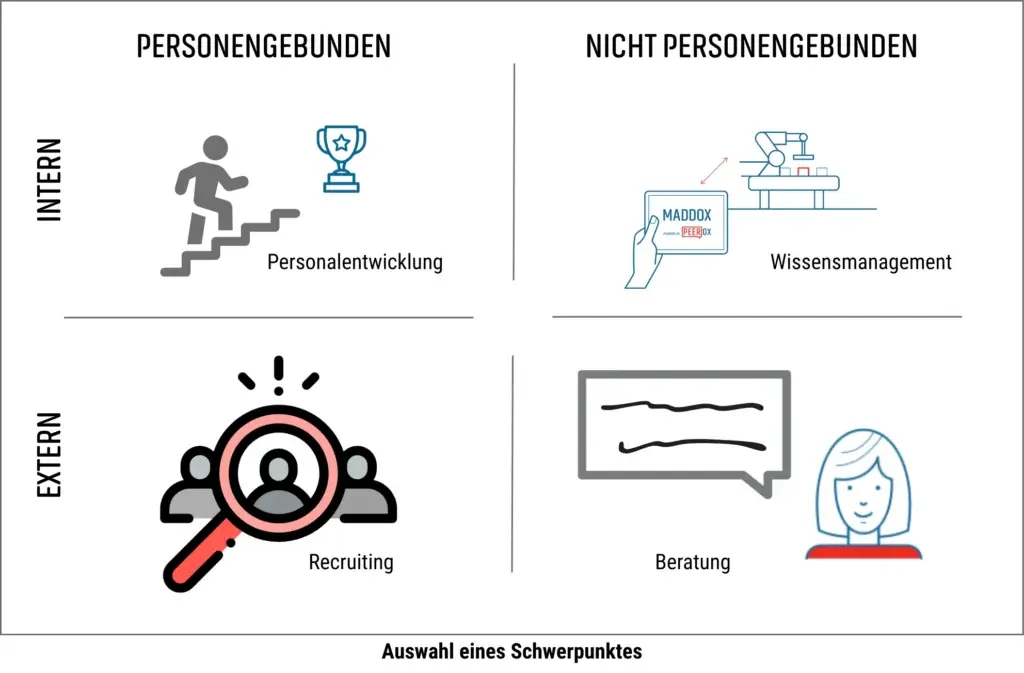
To develop a world-class solution, you must solve a very specific problem that suits you. For the topic of knowledge in production, the following matrix provides good orientation:
The transitions between the individual areas are, of course, fluid. For example, good knowledge management contributes to further training, and the recruitment of ambitious employees contributes significantly to the success of personnel development. Nevertheless, in the interest of focus, you should place your emphasis on one of the areas.
Personnel Development
Target State
This is not about an annual training offer or the opportunity to complete a Master Craftsman certification alongside work. Your company has a reputation as the ultimate practical academy. Anyone who wants to learn and experience a lot after graduation must come here. There are fabulous trainee programs, etc.; your employees have an elite reputation in your industry, and only a few of the many applicants are even accepted.
Advantages
You attract high-performing applicants and can select the best. They see the offer of professional and personal development as a central added value, allowing you to realize low personnel costs. Often, a positive internal dynamic also arises in the team to live up to the reputation as an elite.
Disadvantages
The challenge lies in retaining employees after their training.
Recruiting
Target State
You offer an outstanding overall package specifically for the specialists you need. One component of this is an attractive salary, but this is usually not the most important lever. Young parents working shifts are enthusiastic about a kindergarten that is superior to state institutions with adapted opening hours. Furthermore, experienced specialists are often willing to change jobs due to a negative corporate culture and poor management. Ensure a top environment and excellent managers in these aspects. To make these advantages effective, you need a recruiting team that is well-positioned in terms of communication and processes.
Advantages
You hire already highly qualified specialists and can benefit from their expertise without major additional investment.
Disadvantages
Even if salary is not the decisive criterion, relatively high personnel costs arise. Employees who were willing to switch to you will also switch away again if the boundary conditions no longer fit.
Consulting
Target State
You benefit immediately, tailored exactly to your problem and only to the extent required, from the knowledge of the best experts. An advantage over other companies arises from knowing the best consultants on the market and a coordinated network that creates synergies between various specialized consulting and services. You are outstanding in the discipline of “knowing the right people for every situation.” Some problems can be permanently solved in this process through technical or organizational adjustments. Other solutions must be sustained by employees, creating a cross-reference to personnel development. Thinking this through consistently, you can also purchase these as a service and do not have to build the necessary structures and content yourself.
Advantages
Generally well-suited if solutions are needed quickly or if no internal resources are available to implement the other options.
Disadvantages
The expertise does not enter the company sustainably, creating dependencies that can cause high costs in the long run.
Knowledge Management
Target State
In your company, there is an optimal system that stores knowledge and makes it available. Processes for knowledge documentation are established and actively practiced. Anyone who wants to solve a problem uses the knowledge management system as the first point of contact. If you need to pay less attention to technical expertise during recruiting, you can focus more on important soft skills and still have a sufficiently broad offer on the labor market. Scaling is not a hurdle; whether across shifts or locations: your knowledge management system supports your employees in every situation.
Advantages
This is the only one of the four areas mentioned in the matrix where knowledge actually becomes part of the company’s intangible capital. In contrast to person-dependent options, your know-how is threatened neither by fluctuation nor by demographic change. With a user-friendly knowledge management system, even people who are not specialists (and cause correspondingly lower personnel costs) can perform well after a short induction period.
Disadvantages
The knowledge management system must first be filled with content and established. For the system to become established and accepted by everyone, very good change management and a certain startup period are required.