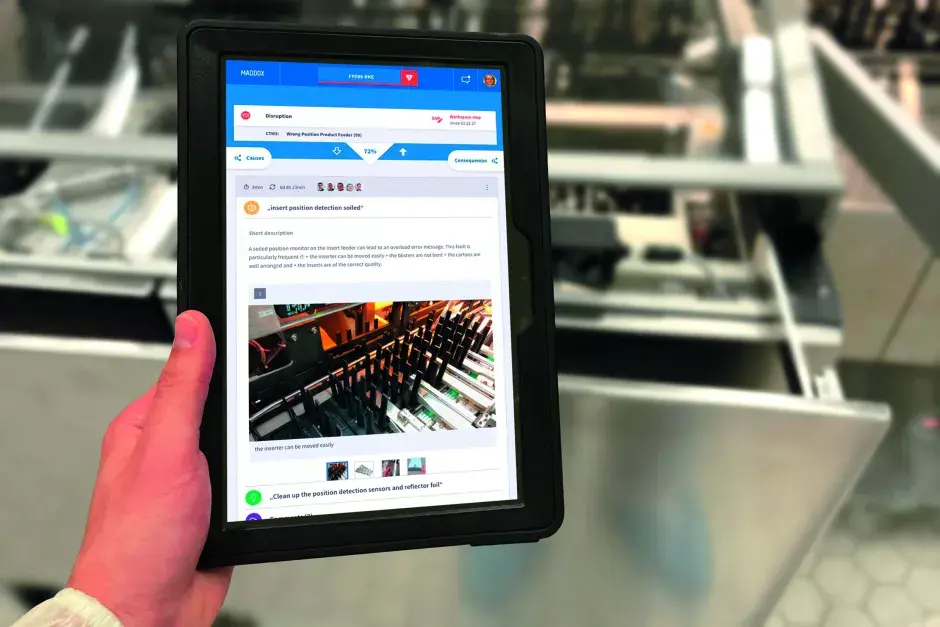


“If I really have to write everything down, I’ll never finish!” – Anyone who has dealt with organizational knowledge management knows this problem. At the same time, however, one frequently hears the complaint: “Often even the simplest things aren’t done correctly!”
How can you achieve a sensible level of detail in knowledge documentation despite these conflicting requirements?
Let go of outdated misconceptions and focus on your target audience! With the following tips, you can achieve noticeably greater production efficiency and fewer unplanned downtimes in your manufacturing with minimal effort – even with changing or inexperienced machine operators.
Common Misconceptions About Knowledge Documentation
Writing everything down in great detail is time-consuming, but at least ensures that no errors occur.
People are not computers that reliably execute every line of code. Our short-term memory can store a maximum of 6…7 pieces of information. Feel free to test this yourself by having phone numbers of varying lengths read to you and trying to remember them. Especially when people need to combine multiple pieces of information and keep them in mind, they quickly reach their limits.
Furthermore, due to evolution, we tend to strive to achieve the necessary results with as little effort (energy expenditure) as possible. Some call this trait laziness; at the same time, however, it is often the origin of creative solutions. Regardless of how you view it, beyond a certain length of knowledge entries, our brain assesses the shorter duration of “trial and error” – weighted by the lower probability of success – as still the better path, so that overly detailed knowledge entries are not read.
With reasonable people, you can assume certain things and don’t have to write everything down.
Unfortunately, this assumption cannot be made across the board. The human brain is very good at associating. Basic knowledge that we have about something can easily be transferred to similar things or situations. Someone who can drive a car will probably get the hang of a tractor relatively quickly, and the transition from, for example, Windows 7 to Windows 11 also works because the connection to basic knowledge can be established in each case. It is different when the basic knowledge and the associated mental models are completely absent. Someone who has never worked in automated production will be overwhelmed even by small problems. Unfortunately, nothing is generally logical or intuitive, but always only associatively accessible. This basic principle is largely independent of intellect. When people appear “stupid,” they usually lack the necessary basic knowledge.
Therefore, you must look for the intersection of basic knowledge in your target audience to decide what you can assume and thus do not need to document. The previous professional background usually provides a reference point. For example, if you want to support a former baker and a former nurse at a thermoforming machine, you will probably need more details than with trained automotive mechanics.
Target Audience-Oriented Documentation – Here’s How
The correct assessment of what needs to be documented and what does not usually does not work well at the beginning – but can be learned. A fundamental difficulty is that one often no longer remembers the process of knowledge acquisition and the associated challenges.
The key therefore lies in observing your target audience in the following steps:
How to Improve Knowledge Documentation – Especially for Inexperienced Machine Operators:
1. Start Small
Write a small number (5…10) of knowledge entries on the most frequent/relevant topics. Choose the level of detail intuitively based on your prior knowledge of the target audience. Tend to reduce your expectations and be satisfied with 80% for the beginning (Pareto principle).
2. Test the System in Practice
Introduce the knowledge management system into practice on a trial basis and communicate this.
3. Use Follow-Up Questions Strategically
In most cases, your colleagues will not yet use the new system to the desired extent and will still ask you as an experienced person for help when you are nearby. Use this by referring them to the appropriate knowledge entry and “staying available for questions.” This achieves three things:
- You can reduce apprehension, because you are there in case questions still arise.
- Your colleagues learn: “If I ask a question about something that is in the new knowledge management system, I will be referred to it anyway. So I might as well use it before I go ask.” This way, you can shape habits for using the knowledge management system in the medium term.
- You can observe the target audience using the documented knowledge without the person feeling observed and therefore possibly behaving differently. This way, you learn at which point how much detail is needed in the knowledge documentation to make it optimally usable.
This approach sounds trivial, but after just a few iterations it will bring you a good deal closer to the goal of effective and actively used knowledge management for your production.
If you want to improve your knowledge documentation in a targeted way – especially for changing or inexperienced machine operators – it is worth taking a look at modern, digital solutions.